On October 21, Microsoft announced broad Advanced Shader Delivery availability. NVIDIA needs driver 621.01 or newer. Steam, Epic Games Store and Fortnite’s ASD update remain ahead; Unity support is expected in 2027.
The problem ASD actually addresses
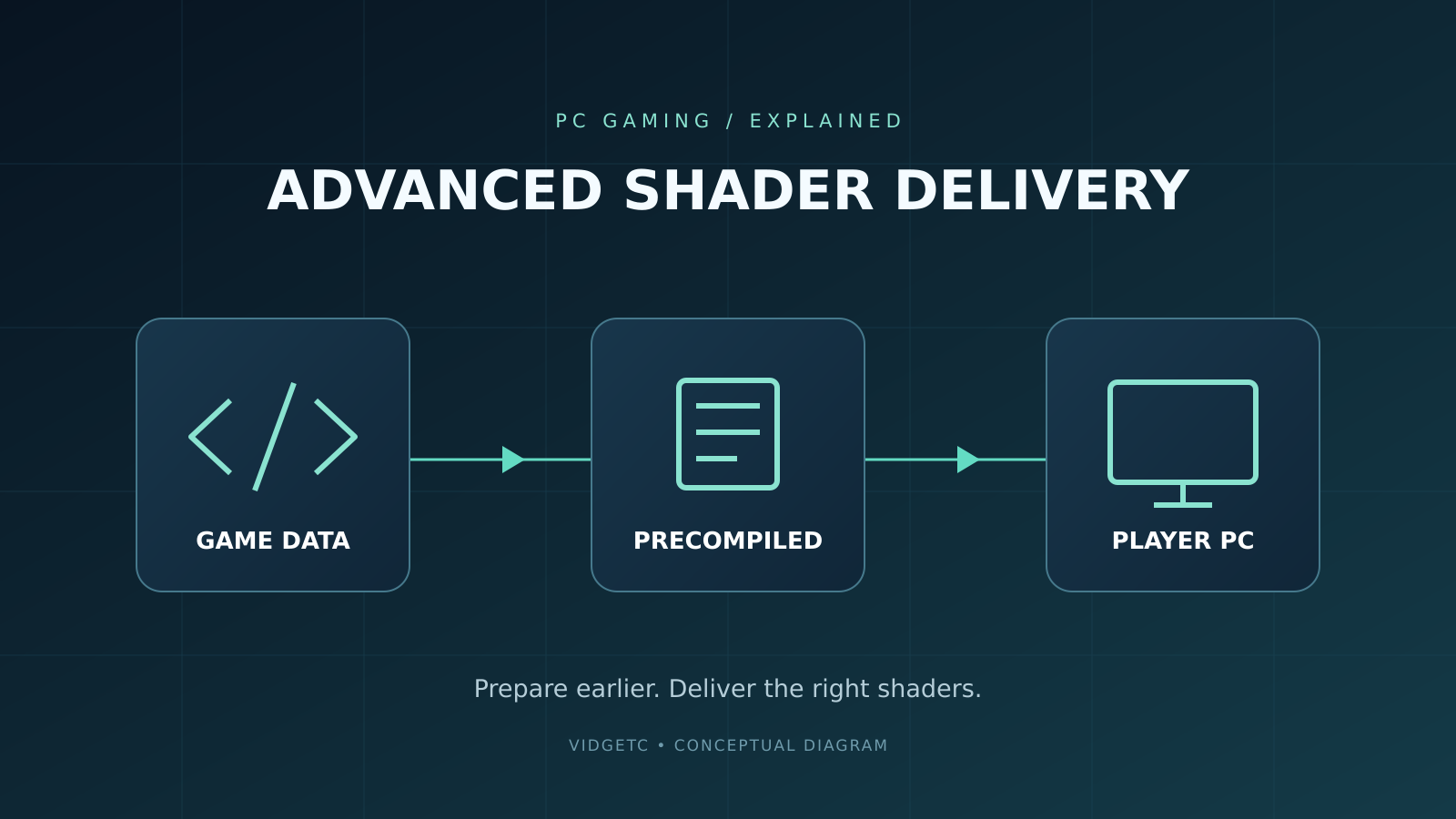
Advanced Shader Delivery moves shader preparation away from the player’s PC and ahead of delivery. It is a Windows 11 and Direct3D 12 technology: reducing local compilation can shorten the first launch, reduce related hitches and save energy. Its target is a particular graphics-preparation workload, not every operation a game performs.
Direct3D 12 combines much of the graphics pipeline’s state into a Pipeline State Object, or PSO. This describes more than an individual shader: it brings together related execution settings. When the object is created, the driver can prepare the corresponding hardware representation. That makes “why not just ship finished shaders?” a more complicated question than it sounds.
An ordinary PSO cache is not universal either. Microsoft’s documentation ties cached data to its hardware, driver and originating machine. An incompatible driver version or different adapter can produce a mismatch error. A random cache copied from someone else is therefore not a reliable substitute for an official delivery mechanism targeting the relevant configuration.
What is being delivered
The foundation is an SODB, a database of state-object descriptions and the necessary shader data. It preserves inputs used to build a precompiled cache. A fallback path remains when a required object cannot be found in that cache. Delivering a prepared result is therefore different from removing compilation from the game’s architecture altogether.
A useful analogy is a shop delivering a prepared kit for your system instead of asking every buyer to assemble equivalent parts independently. It does not mean every computer receives the same file. The practical point is that several layers of support have to line up. A graphics-card brand alone is not enough to establish that the complete experience will work.
Which systems qualify
Microsoft’s baseline is Windows 11 24H2 or newer. Its AMD list covers RDNA 1, 2, 3, 3.5 and 4 with Adrenalin 26.6.1 or later. Qualcomm coverage names Snapdragon X2 Series with driver 2026.08.3 or later. These are ASD compatibility requirements, not the minimum specifications for an individual game.
Intel confirms ASD in driver 32.0.101.9150 for Arc B-series, Core Ultra Series 3 and certain Series 2 notebooks with integrated Arc graphics. Do not extend this to every device that can install the driver: package compatibility and feature support differ. Notebook owners should also check their manufacturer’s guidance on OEM drivers.
NVIDIA describes GeForce RTX support and delivery of the appropriate database through the Xbox PC app for compatible Microsoft Store games. Its current examples include Gears of War: E-Day and Call of Duty: Modern Warfare 4. That does not establish ASD availability for every copy of the same title purchased through another storefront.
What to check before launching
Microsoft’s official catalogue also lists Avowed, Forza Horizon 5, Hogwarts Legacy and S.T.A.L.K.E.R. 2. Supported launch screens indicate operation with “Precompiled shaders installed.” Check the catalogue for the particular game rather than treating one successful example as proof that an entire library is covered.
Microsoft also announces SODB integration in Unreal Engine 5.8.4. For Modern Warfare 4, it asks players to install the Xbox PC app before downloading the game.
A sensible checklist starts with Windows version, graphics model, driver, storefront and title support. Then compare the same route and settings. Leaving a preparation screen sooner does not prove higher average FPS.
Individual long frames matter when assessing smoothness, not just an attractive average. We have not conducted an independent benchmark and do not present manufacturers’ claims as our own measurements.
Why some hitches can remain
Microsoft’s integration guide explicitly discusses incomplete coverage: capture runs can miss scenes, settings or GPU-specific paths. Developers should examine the cache hit rate; Microsoft regards 90% or higher as a good result. That measures how the prepared database works, not a guarantee that every frame will finish on time.
Unreal Engine 5.8’s documented ASD tool targets Windows D3D12 SM6 and does not support ray-tracing PSOs. Epic recommends retaining PSO precaching; missing objects compile normally. Its documentation schedules Epic Games Store support for early 2027. These tool-specific limits must not automatically be applied to every ASD implementation.
Precaching itself also consumes resources. Epic explains that background compilation uses threads and memory, while retrieving an already prepared PSO from a driver cache can still take milliseconds. Engine decisions about when preparation happens and how memory is managed therefore remain important even when the main compilation happened earlier.
The wider implication for developers
Microsoft is also developing partial graphics programs, reusing common program components rather than duplicating work across very large PSO collections. At GDC it separately discussed application identity and cache-hit statistics. Scaling ASD consequently involves verification tools and coordination, not simply adding another switch to a driver.
Our assessment: the most interesting change is organizational. Graphics preparation becomes part of the game-release and delivery chain. Players benefit when the publisher, storefront and driver supplier all support that chain.
The useful near-term question is therefore not merely whether ASD exists, but how many games you actually want can receive the correct data without additional effort.
Buying a new GPU solely for this feature would be premature, as would expecting it to fix memory shortages, slow asset delivery or game bugs. That is our practical conclusion about the technology’s purpose, not an additional Microsoft promise. This article reflects information checked on October 22, 2026; storefront and driver support should be checked again as releases change.
Comments