The EXODUS update published on October 22, 2026 put Jun Aslan back in the spotlight as Archetype presented the protagonist’s revised male appearance. For an upcoming role-playing game, however, the more useful question is what sits behind that appearance. Official material provides a broader picture of the player’s tools, the distinctions between companions and the reasons a journey’s consequences should extend beyond a single mission.
This article separates confirmed information from editorial analysis. It examines the proposed design rather than reviewing a finished game. The material shown is still in development.
What is new, and what was already known?
The October message says a female Jun reveal and a broader combat presentation are still to come. It does not date either. “Soon” is therefore not a basis for assigning a particular week or event to those presentations.
The release date was announced separately: EXODUS is scheduled for April 7, 2027. That announcement came on August 25, not in the October update. The announced platforms are PlayStation 5, Xbox Series X|S and PC. Keeping those dates separate prevents an ordinary development update from turning into an invented new launch announcement.
Jun: appearance and progression
Jun begins as a salvager and becomes a Traveler. An ability to interact with Celestial technology makes the protagonist central to the attempt to save their homeworld. The official description also confirms a choice between male and female versions and appearance customization.
A different choice matters more to the role-playing structure: the Paladin and Immortal alignments are tied to ability progression. That information comes from the June presentation rather than the new portrait. Two alignment names do not establish an exact number of story branches, nor prove that the entire morality system is a simple good-versus-evil meter.
Our assessment is that linking behavior and progression could make decisions tangible outside dialogue. The test is whether it creates different ways of playing, rather than merely changing statistics.
Examples of the same situation with different builds would be useful, along with an explanation of how readily players can change direction. Until those details are demonstrated, a promising design principle should remain a design principle rather than a verdict.
Combat: how the tools work together
The March 27 Khonsu combat presentation showed the Recycler switching modes and the Lance ability. Its official description places Jun alongside Tom and Elise. The foundation already suggests a combination of gunplay, special abilities and squad support.
A later presentation expanded the toolkit with enemy detection, stealth and distraction options. Having several tools does not, by itself, establish freedom in every encounter. Level design sits between an interesting ability menu and several genuinely viable tactics.
The most useful next demonstration would show one section tackled in different ways. How do enemies respond after detecting the player? Can stealth be recovered? Does using an ability create an opening for a companion?
Examples would explain the system better than a montage of successful attacks. These are questions to investigate, not features we are claiming the developer has promised.
Companions: not every character is a combat recruit
The official Your Journey page distinguishes combat companions from story companions. This is an important qualification: appearing in the story does not automatically mean a character can join every firefight. Named crew members include Tom Vargas, Elise Charroux, Salt and Emrys, with different amounts of detail available about their roles and backgrounds.
The August material describes Salt as a mech-based combatant with sniping and smoke-screen capabilities, while Emrys provides support that weakens enemies and helps Jun. In design terms, those are distinct tactical roles rather than different portraits next to a health bar.
Our assessment is that the crew’s appeal will depend on whether mechanical differences connect with personality. A companion who fights differently and challenges the protagonist’s decisions gives players a reason to choose a team beyond maximizing damage.
That does not justify filling in the party size or command system from other familiar RPGs. Those details need evidence of their own.
Time as a consequence of travel
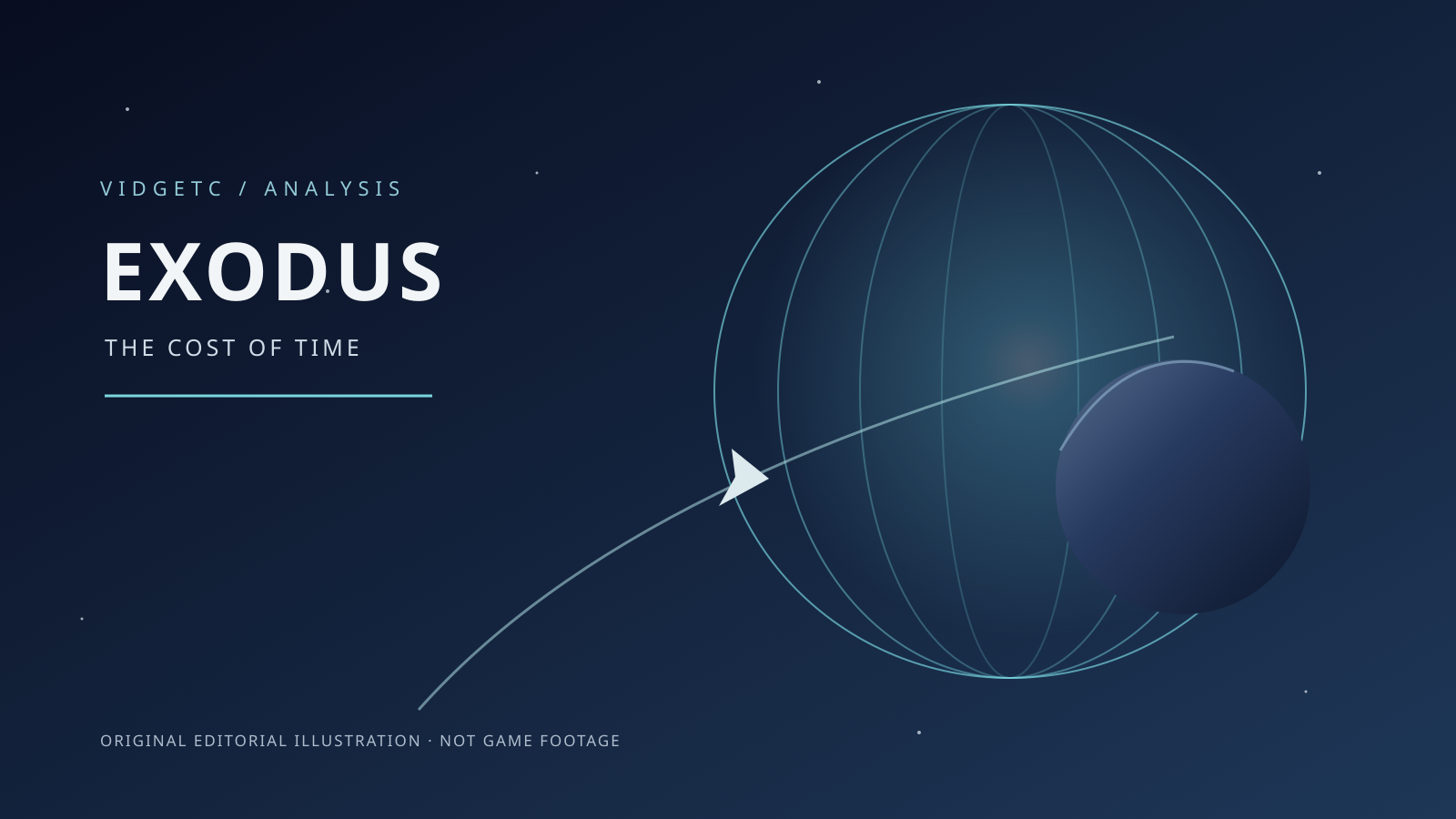
The official April 2024 explanation of time dilation describes a difference between the time experienced by travelers and by people who stay home. Returning can mean encountering an older social world. This longstanding premise is useful context for EXODUS, not a newly announced October mechanic.
For the story, the approach could increase the cost of a decision: the player cannot simply return to the previous state of the world. Its effectiveness still depends on execution.
A changed backdrop and a line about passing years would produce one effect; altered relationships and consequences linked to the player’s own actions would produce another. The broad premise does not tell us which changes occur in every mission.
Another criterion for future demonstrations is whether consequences are legible. A dramatic choice is more effective when players understand the stakes, even if they cannot predict the outcome.
Changes that seem arbitrary weaken that responsibility. The relevant test is therefore the connection between information available to the protagonist, the decision made and the subsequent return, rather than a promised quantity of branching paths.
This is an editorial standard for evaluation, not a report from a completed playthrough.
What to watch next
The outstanding questions concern the depth of systems already described. How often is an alternative approach practical? How do companions respond to decisions? Do the alignment paths remain meaningfully different throughout the game? How visible are the consequences of coming home?
Jun’s revised appearance helps establish the protagonist, but it does not answer those questions. The reason to follow EXODUS is the proposed combination of squad combat, character development and irreversible time. Conclusions about its quality should wait for fuller demonstrations and the finished release.

Comments