
Information checked on October 22, 2026. This is an editorial analysis of official material, not our own hands-on review. Our assessments of potential design strengths are analysis, not confirmed properties of the finished game.
PlayStation Blog’s October 21 preview covered the prologue, Kokura, Kure and Minami. It describes everyday activities improving health and spirit, alongside concert production involving performers, costs and revenue targets. The range of activities in RGG Studio’s Stranger Than Heaven provides a useful starting point for examining its design.
Release date and platforms
SEGA announced January 15, 2027 on June 8. Its platform list includes PS5, Xbox Series X|S, Steam, Xbox on PC and Xbox Cloud Gaming, with Game Pass availability also announced. The October preview is not the original release-date announcement.
The practical takeaway is to avoid buying solely because of a fresh preview or promises of scale. Before launch, checking the terms of your chosen storefront, the relevant subscription tier and independent technical testing on your hardware will be more useful. We are not assessing frame rates, stability or PC quality here: we have no measurements of our own.
A biography rather than a collection of backdrops
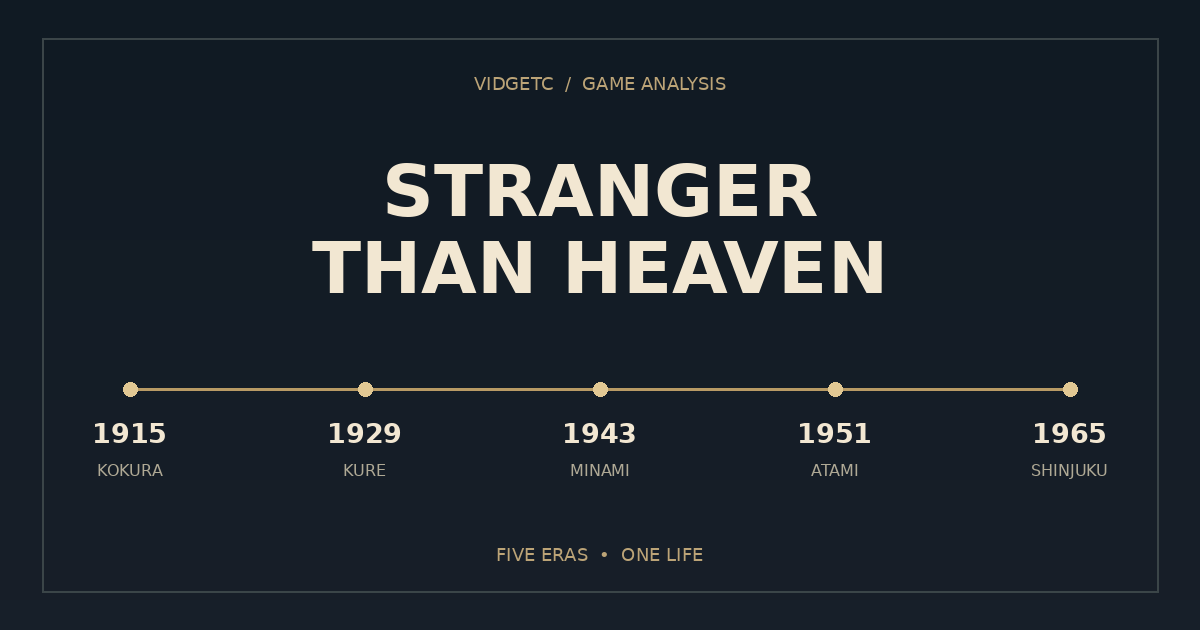
The official website maps five settings: Kokura, Fukuoka in 1915; Kure, Hiroshima in 1929; Minami, Osaka in 1943; Atami, Shizuoka in 1951; and Shinjuku, Tokyo in 1965. Makoto Daito is the central character. This is a narrative itinerary, not confirmation of five equally sized open worlds.
Our reading is that a long biography gives writers a powerful tool while setting a difficult pacing challenge. Players should feel the consequences of a life lived, rather than simply encounter another costume after a time jump. Convincing transitions, relationships and explanations of what changed between chapters will matter more than the number of dates on the itinerary.
In a March Xbox Wire interview, Masayoshi Yokoyama described creating five eras and cities as a major undertaking. The footage also featured trams and environmental interactions. Those early demonstrations establish the project’s ambition; they do not measure freedom or campaign length.
Why the combat controls deserve attention
Xbox Wire’s June preview explains the unusual controls: LB/LT handle light and heavy left-side actions, with RB/RT doing the same on the right. Other buttons support defense, evasion and grappling. It also describes weapon selection and using a free hand against an opponent who has grabbed Makoto’s weapon.
Evaluating that system requires more than counting combinations or watching a dramatic edit. Can players read enemy intentions, understand why they failed and apply what they learned in another encounter?
Clear feedback could make an unfamiliar layout reward attention. Poor feedback could turn the same complexity into a barrier. That is a question for the final balancing, not a verdict based on personal play.
Music as a reason to explore
SEGA’s May overview describes Makoto recruiting singers and musicians while collecting sound ideas for compositions. Everyday noises, transport, animals and fights can provide material. Musical activity is therefore part of the protagonist’s role, rather than simply the soundtrack accompanying events.
Our analysis is that this could be a productive adventure-game principle if curiosity leads to discovery rather than compulsory map-clearing. Connecting a quiet walk with a creative outcome could make quieter passages meaningful.
Repetition, the cost of experimentation and room for an individual approach are the things to assess. Attractive presentation alone cannot establish whether that connection remains enjoyable over time.
People should matter more than the activity list
Xbox Wire’s May account describes Yu Shinjo as Makoto’s friend and rival. Their ambitions diverge, before their paths meet again in show business. Their relationship provides context for the activities shown in promotional material.
For us, the most promising version of this structure is one where an activity changes how the player understands a character. A shared decision or mistake can be more memorable than filling a progress bar.
The opposite risk is that individually accomplished systems interrupt each other when the story forces players away from their preferred activity for too long. The sequence of introductions and returns is crucial.
What a full review needs to establish
We would assess the finished game against four criteria. First, the clarity of its teaching and control settings. Second, whether the campaign maintains momentum between major story beats.
Third, whether optional activities have value without compulsory repetition. Fourth, technical consistency on the actual platform being tested. These are review criteria, not problems we have discovered in an unfinished build.
For now, Stranger Than Heaven deserves attention for its structure rather than inflated pre-release verdicts. Readers interested in dramatic adventures and unusual systems have a reason to keep watching. A recommendation should wait for the complete game: only that can show whether its individual parts remain satisfying together across an entire campaign.
Comments