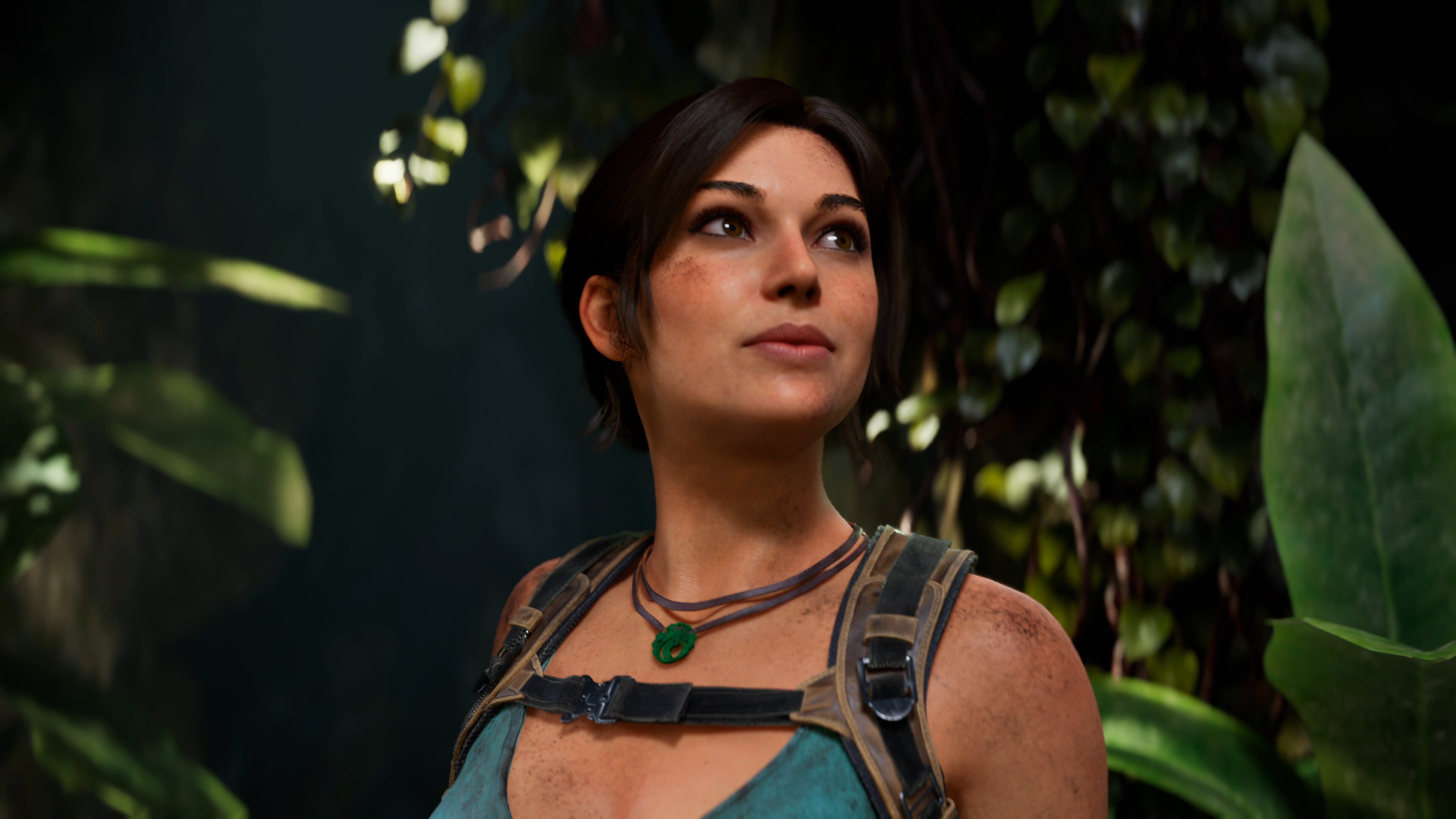
On October 22, PlayStation Blog published Crystal Dynamics and Flying Wild Hog’s account of Lara Croft’s redesign. It describes hair cards, skin scattering, custom facial shapes, clothing scanned on a full-scale, 3D-printed body, and the combination of different Lara eras. One costume was physically tailored before scanning.
PlayStation’s product page identifies Tomb Raider: Legacy of Atlantis as a reimagining of the 1996 game using Unreal Engine 5, with release scheduled for February 12, 2027. This is a pre-release analysis, not a review or hands-on report. The judgments below are our editorial interpretation; the technical documentation explains general methods, not the game’s undisclosed settings.
Recognition has to survive the close-up
Our starting point is that a convincing redesign should work at two distances. In an ordinary gameplay view, a character needs a readable outline and clear movement. In a close-up, that same figure must carry a believable expression.
Detail becomes useful when these views reinforce each other. A face that looks impressive in isolation can still feel disconnected from the person the player controls.
For Lara, we would therefore judge consistency before counting polygons. Does a moment of concentration belong to the same character who confidently crosses a dangerous room? The important connection is between appearance and intention, not between a new model and a particularly flattering promotional frame.
Hair and skin are different problems
Epic’s groom documentation allows different detail levels to use strands, cards or meshes. Cards have their own geometry, textures and materials. The term therefore describes a representation, not a promise that every hair is individually simulated.
Our practical test would be simple: watch the character turn against a bright background, then move the camera. Does the hairstyle retain its shape? Does it distract from the face? These are proposed review checks, not defects we have observed. A sophisticated asset should help a scene remain readable while attention is elsewhere.
Epic describes Subsurface Profile as a skin-oriented shading method whose artist-controlled parameters govern light scattering. It also stresses that matching the texture’s base colour matters. This illustrates a general rendering principle, without identifying Lara’s exact shader configuration.
Our inference is that lighting consistency matters more than a single beautiful complexion. A character should still belong in the environment when the scene changes from open daylight to a darker interior. We would look for continuity rather than demand identical skin colour under different lights.
Facial detail needs a performance
Epic defines a morph target as a changed set of mesh vertex positions. Blending such shapes can produce an expression. That gives artists a way to represent facial movement; it does not decide when a character should smile, hesitate or look away.
For this redesign, a useful question is whether expression makes thought legible. A short glance at a mechanism could communicate assessment before a line of dialogue explains anything. We would value that economy of acting more than constant animation. Restraint can give an adventurer authority; an endlessly busy face could undermine it.
What a clothing scan can and cannot settle
Our reading of the physical-costume workflow is that it provides a concrete reference for artistic decisions. A seam, a fold and the way fabric sits against the body can be considered together instead of as unrelated decorative marks. The interesting result would be an outfit that looks worn by someone, rather than laid over a character as a separate visual layer.
However, an observed configuration is not evidence of every possible movement. We still need to see the clothes during a jump, a landing and an abrupt turn. The announcement alone cannot establish cloth-simulation quality, collision behaviour or the cost of those effects. It would be premature to promise realism everywhere because one production step used real material.
Bringing eras together requires priorities
Our main concern with a cross-era interpretation is coherence. A design can acknowledge several audiences yet become indecisive if each scene seems to favour a different personality. We would rather see a clear hierarchy: curiosity motivates the decision, competence shapes the response, and consequences give the risk weight.
This is a proposed standard, not a description of the finished story. Imagine a room with an uncertain route. A coherent Lara could stop, assess and deliberately proceed without needing either a joke or a crisis to justify the moment. Vulnerability could appear in the effort required; confidence could appear in choosing to continue.
What to watch before launch
The most useful next evidence would be a sustained gameplay sequence showing movement, dialogue and changing light without constant cuts. Close-ups alone cannot answer questions about responsiveness or visual continuity. We have not measured frame rates, compared console modes or played the game.
Our conclusion: judge the redesign by how clearly Lara thinks and acts on screen. Richer surfaces are worthwhile when they support that character. As of October 23, 2026, the February release remains ahead, and the production story is more complete than the evidence needed for a verdict.
Comments