
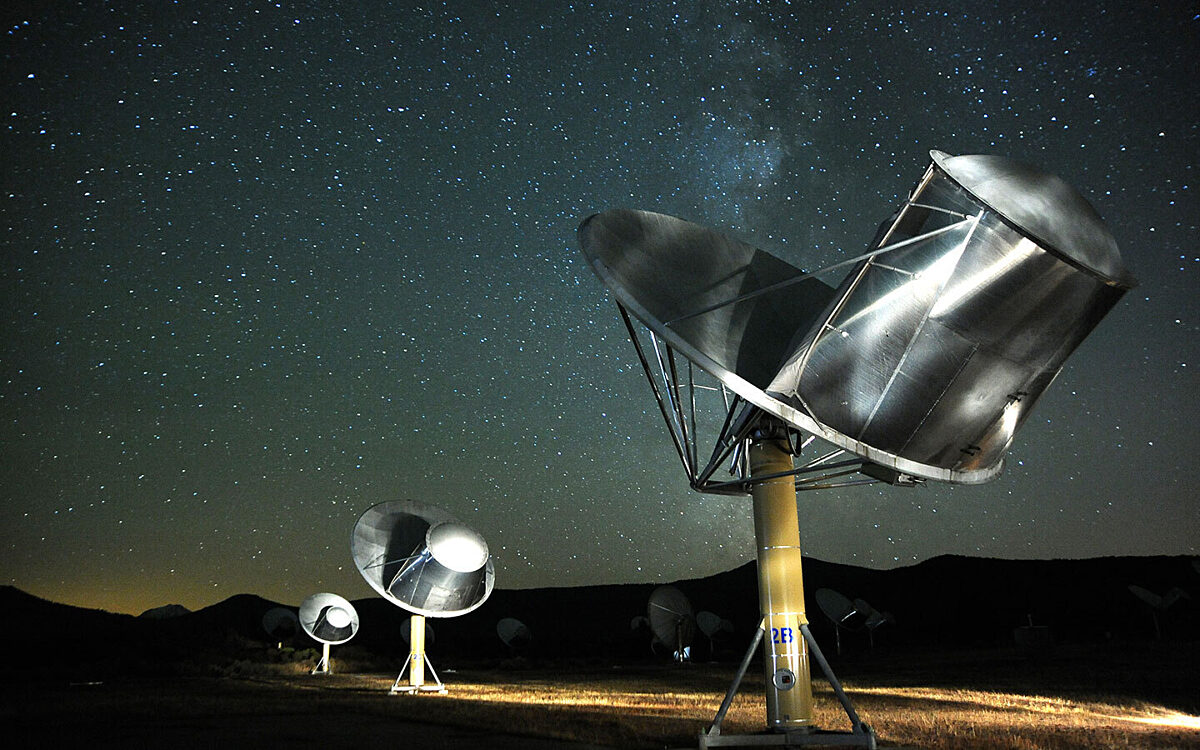
On October 30, 2026, NVIDIA reported agentic AI use at the Allen Telescope Array involving the SETI Institute and Breakthrough Listen. The system carries out observing tasks from natural-language requests.
Its reported demonstrations include real-time detection of the Crab pulsar. The announcement contains no confirmation of extraterrestrial intelligence and provides no precise deployment date.
Why automate an observatory?
The Allen Telescope Array in Northern California comprises 42 antennas, each six metres across. The SETI Institute describes it as an instrument designed specifically for the search for extraterrestrial intelligence that also supports radio astronomy. That dual role matters: observations of familiar cosmic sources help researchers assess their equipment.
For readers, the useful distinction is between answering and acting. A chatbot can describe an observation; a software agent must arrange its execution through available tools. Our editorial yardsticks for such a system would be operational records, reproducibility and measurement quality, rather than how persuasive its explanations sound.
Getting measurements into the pipeline
DAQIRI documentation describes moving sensor streams into GPU-accessible memory. That supports filtering and processing as measurements arrive while reducing pressure on storage. AI in this chain does not replace the radio receiver: it works with the output of a physical measurement.
CyberEther represents processing as a graph of connected blocks. Its official website describes editing this graph while it is running, without a separate restart, and GPU acceleration. The practical attraction is straightforward: a researcher needs to change the sequence of calculations and inspect the consequences, rather than simply archive a stream for later analysis.
The Stelline project separately describes Nexus as a tool for coordinating computing clusters and observations. Its page lists a claimed system throughput of 2.4 terabits per second. That is a data-rate figure, not a probability of finding a civilization. Without test conditions, it cannot establish a universal speedup for every astronomical investigation.
What the pulsar result means
NASA describes the object at the centre of the Crab Nebula as a neutron star rotating about 30 times each second. It is a known natural source. Recognising it again with a new processing pipeline should be distinguished from discovering the object itself.
From an engineering perspective, a familiar target is useful as a control example: researchers have an expected result against which to compare the output. But one successful example does not establish how many faint signals the system will miss or how many false alarms it will generate. Those questions require separate testing.
What still needs demonstrating
The SETI principles updated in June 2026 emphasize scientific verification of potential evidence and responsible communication of a confirmed detection. An automated instrument does not remove that stage.
Our assessment is that the most interesting prospect is a shorter path between a measurement and the observatory’s next action. Judging scientific effectiveness will require open methods, comparisons and error statistics. For now, this is a development in how observations are organized, without a sensational conclusion about aliens.
Allen Telescope Array. Photo: Seth Shostak / SETI Institute, CC BY 3.0. Archival illustration, not a photograph of the 2026 demonstration. Photo source · CC BY 3.0. No changes by Vidgetc; the supplied 1200×750 file is used.
Comments