
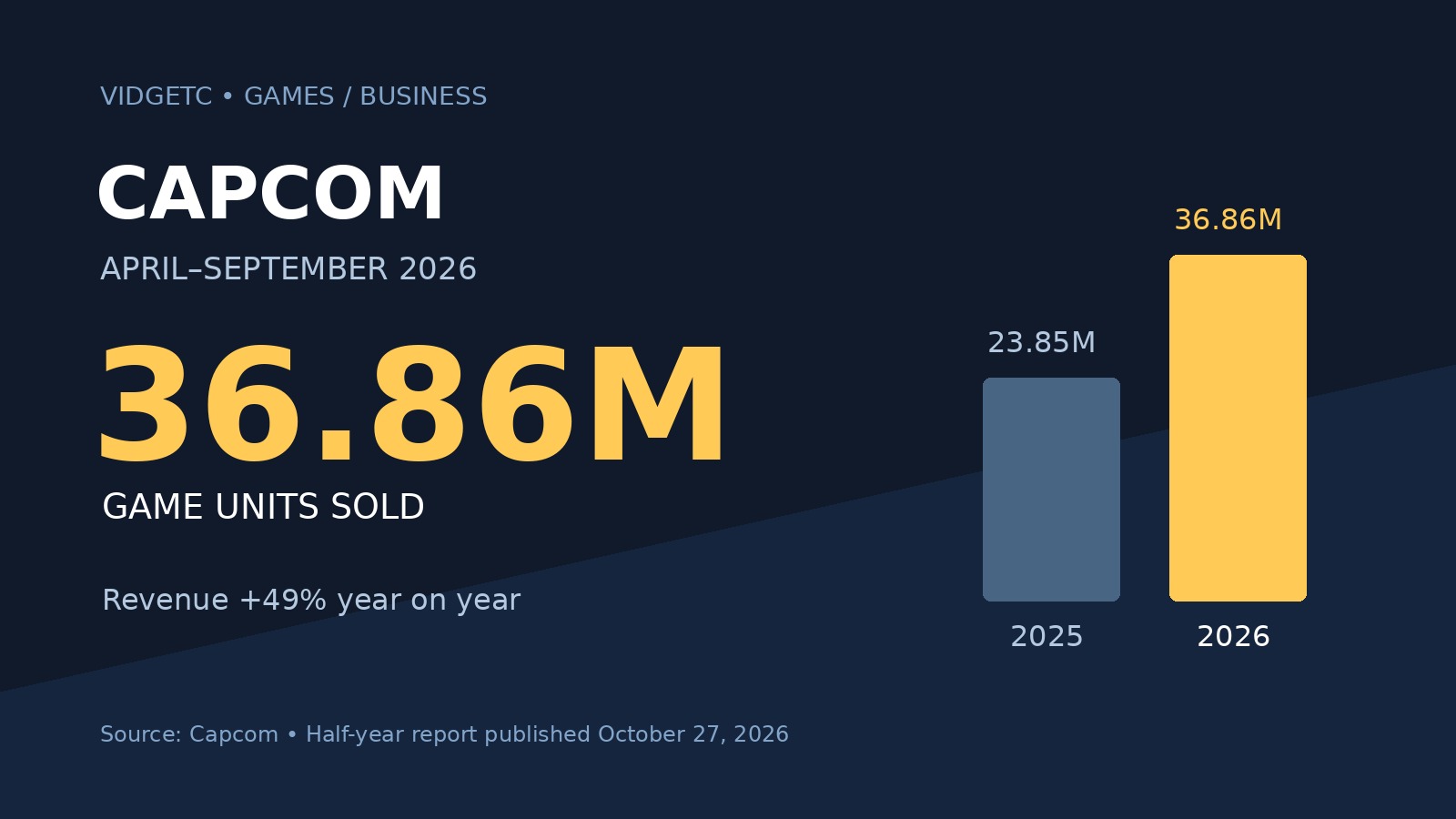
Capcom published its results for the six months ended September 30, 2026, on October 27. Game sales reached 36.86 million units, compared with 23.85 million a year earlier, while consolidated revenue rose 49%.
The figures reflect a combination of new releases and continuing demand for older games. Here is what the report establishes, how the catalogue fits into the picture, and which conclusions the available numbers cannot support.
What the reporting period covers
The results cover April 1 through September 30, the first half of Capcom’s financial year ending March 31, 2027. The publication date is not the end of the accounting period. Events in October should therefore not automatically be counted as contributors to the six-month result.
Capcom reported revenue of ¥120.887 billion and operating profit of ¥60.769 billion. Operating profit increased 54.5%, faster than revenue. Profit attributable to owners of the parent reached ¥43.083 billion, up 56.6%. These are different measures: revenue describes the monetary size of the business, while profit reflects the relevant expenses and other accounting items.
Game sales increased by 13.01 million units. Calculating the change from the published totals gives growth of approximately 54.5%. The word “units” matters here. It does not mean unique customers, active players or subscribers. Someone can buy several games, and the combined number does not show how purchases were divided between platforms.
Onimusha is one contributor, not the whole explanation
Capcom highlights Onimusha: Way of the Sword among its important new releases. According to the company, worldwide sales exceeded 1.7 million units. It describes the game as the series’ first new installment in 20 years and attributes its performance to positive reception of the gameplay experience.
That assessment is the publisher’s explanation, rather than a conclusion from an independent Vidgetc review.
The Onimusha figure helps illustrate the importance of fresh releases, but it does not explain the entire increase. The overall total covers numerous games. The short announcement does not provide a complete title-by-title sales breakdown, so it would be misleading to assign exact revenue contributions to individual franchises or name one game as the sole reason for the stronger half-year.
For players, the interesting idea is the return of a series: a new entry can bring attention back to an established brand. However, this report does not specify how much sales of older Onimusha games increased after Way of the Sword. A plausible catalogue effect should not be presented as a measured result without the supporting numbers.
Why Resident Evil and older games matter
Capcom separately points to continuing interest in the latest Resident Evil installment and growth in sales of earlier entries, supported by pricing initiatives. In this context, catalogue games are titles that continue selling after their original launch. Their audience can include newcomers to a franchise as well as people who waited for a more attractive offer.
Our editorial interpretation is that a new release can serve as an entry point to a series, while an accessible back catalogue gives that audience somewhere to go next. This helps explain why a publisher’s business cannot be understood solely through the opening sales of its newest blockbuster. The commercial life of its existing library matters as well.
The announcement does not disclose the precise catalogue share, discount levels or number of new Resident Evil customers. Nor can an average game price be calculated by dividing all of Capcom’s revenue by game units: consolidated revenue includes other business activities. Sales volume also cannot settle a debate about the quality of one game compared with another.
The business extends beyond PC and consoles
Digital Contents is identified as the main driver, but Capcom is not solely a seller of video games. The report also mentions existing and new arcade formats and sales of a new pachislo machine. Those operations belong in the interpretation of the consolidated figures, even when the games business is the main interest for readers.
The company also discusses using its intellectual property in film, television, esports, merchandise and events. One chronological detail deserves particular care. The Street Fighter film mentioned in the release opened on October 16, after the September 30 reporting cutoff.
Its inclusion in the corporate narrative does not establish that October box-office activity contributed to the half-year revenue figure.
Projects outside games may broaden awareness of a franchise, but the scale of any resulting effect requires separate evidence. This announcement does not measure how many customers discovered the games through a film or an esports competition. Keeping those limits visible is more useful than treating every brand initiative as a quantified sales driver.
The full-year forecast has not changed
Despite the growth, Capcom maintained the annual forecast originally announced on May 13. For the year ending March 31, 2027, it still expects revenue of ¥210 billion, operating profit of ¥83 billion and profit attributable to owners of the parent of ¥58 billion.
Those figures are management expectations, not guaranteed outcomes. Simply doubling the first-half result would be an unreliable way to predict the year: release schedules, the mix of sales and expenses are not necessarily distributed evenly. Maintaining guidance does not, by itself, confirm a future slowdown or undisclosed problems with a particular game.
For the games industry, the useful conclusion is that Capcom has reported a strong half-year with both new products and the longer commercial life of its library contributing to its account of the business. Future reports will help establish how durable that pattern is.
For now, confirmed sales and reported financial results should remain separate from expectations about the next wave of releases. This article explains a games publisher’s business and is not investment advice.
Comments